

Why Mobile Home Trade-Ins Are Growing in Popularity
Can you trade in a mobile home? The answer is a resounding yes! For homeowners looking to upgrade their living situation, trading in a mobile home has become an increasingly popular and intelligent financial move. It allows you to transition seamlessly into a new, modern manufactured home without the significant stress and uncertainty that comes with selling your current home on the private market.
This guide will walk you through how the process works, its benefits, and what you need to know to get the best value for your home. Let’s start with the basics of who is eligible.
Quick Answer: Mobile Home Trade-In Eligibility
While the general answer is that most homes are eligible, several factors determine the specifics of a trade-in offer. Understanding these elements will help you set realistic expectations.
- Any Mobile or Manufactured Home Can Be Considered: Whether you own an older mobile home or a more recent manufactured home, it can likely be traded in. The key difference is that homes built after June 15, 1976, adhere to the federal HUD Code, which standardizes construction and safety. This makes them easier to value, but pre-1976 homes are still frequently accepted for trade-in.
- Homes Built After 1976 Have NADA® Values: The NADA® Manufactured Housing Appraisal Guide is the industry standard for determining the book value of a home, similar to the Kelley Blue Book for cars. If your home was built after 1976, a dealer can quickly look up its baseline value, which serves as a starting point for the appraisal. Homes built before this date require a more manual market-based appraisal.
- Outstanding Loans Don’t Prevent Trade-Ins: Many homeowners worry that having a mortgage will prevent them from trading in their home. This is not the case. The dealership will work with your lender to get a payoff amount, which is then handled as part of the new home transaction. If your home is worth more than you owe, the positive equity is applied as a credit. If you owe more than it’s worth (negative equity), the difference can often be rolled into the financing for your new home.
- Condition is a Major Value Driver: A well-maintained home will always command a higher trade-in value. Appraisers look at the structural integrity of the home, including the roof, floors, and walls. They also assess the condition of major systems like HVAC, plumbing, and electrical. A home that is clean, in good repair, and has been cared for will receive a much better offer than one that needs significant work.
- Location Affects Value Significantly: Where your home is currently located plays a crucial role in its value. A home that can be traded “in-place” within a community—meaning the dealer buys your old home and puts your new one on the same lot—is worth considerably more. This is because it avoids the substantial costs associated with dismantling, transporting, and setting up a home elsewhere. A “pull-out” trade-in, where the home must be removed, will have these moving costs deducted from its value.
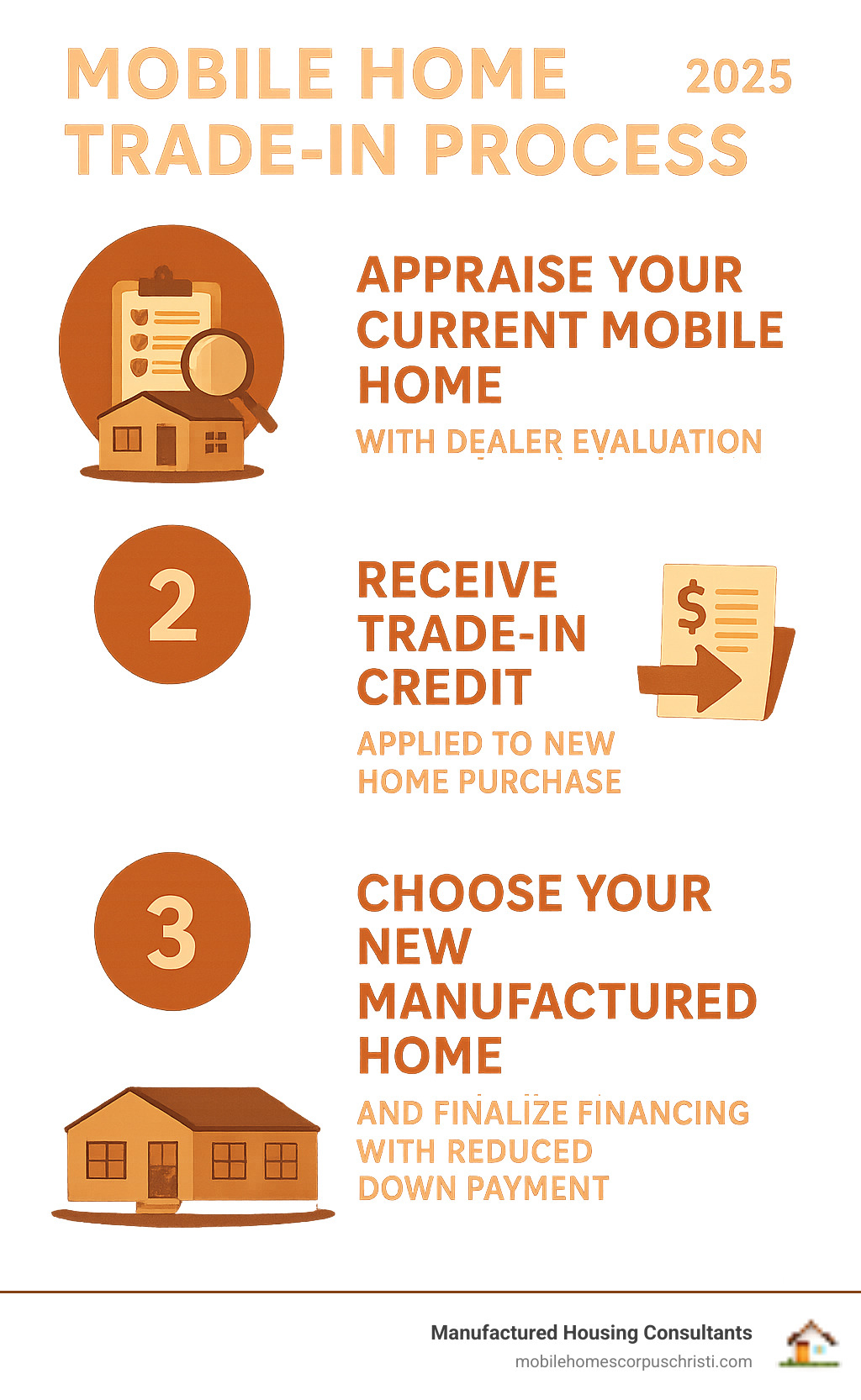
Mobile home trade-ins function much like trading in a vehicle. You present your current home to a dealership for evaluation, they provide you with a trade-in value, and that amount is credited toward the purchase of a new manufactured home. This credit can dramatically lower your required down payment, reduce your monthly payments, or even cover the cost of upgrades for your new home.
The popularity of this process stems from its efficiency. It eliminates the need to find a private buyer, manage endless showings, negotiate complex contracts, and worry about the timing of your sale and new purchase. Furthermore, you gain a significant tax advantage: you only pay sales tax on the difference between your new home’s price and your trade-in’s value, not the full purchase price of the new home. This can lead to thousands of dollars in savings.
Whether your family is growing and needs more space, you desire the energy-efficient features of a modern home, or you’re simply ready for a fresh start, trading in your mobile home is a practical and affordable path to achieving your homeownership dreams.
Basic can you trade in a mobile home vocab:
Understanding the Mobile Home Trade-In
If you’ve been dreaming about upgrading to a newer, more spacious, or more energy-efficient manufactured home, you’re not alone. Thousands of homeowners across Texas are finding that trading in their mobile home is the simplest and most direct path to achieving that dream. It’s a modern solution that sidesteps the traditional complexities of real estate transactions.
The core appeal of a mobile home trade-in lies in its profound simplicity. Instead of the daunting task of juggling two separate transactions—selling your old home while simultaneously buying a new one—you consolidate everything into a single, smooth, and professionally managed process. This eliminates the stress of uncertain timelines, unreliable buyers, and the financial pressure of potentially carrying two home payments.
What is a Mobile Home Trade-In?
A mobile home trade-in operates on a principle very similar to trading in your car at a dealership. You bring your current mobile or manufactured home to a qualified dealer, who then conducts a professional appraisal to determine its market value. That value is then given to you as a trade-in credit that you can apply directly toward the purchase of a brand-new home from their inventory. This credit acts as a substantial portion of your down payment, or in some cases, all of it. It directly reduces the total amount you need to finance, lowering your future monthly payments.
Think of it as a direct exchange of your current home for a better one, with the dealer acting as the facilitator for the entire event. The dealer’s team manages all the intricate paperwork, from paying off your existing loan to transferring titles and finalizing the new sales contract. You are shielded from the logistical headaches, allowing you to focus on the excitement of choosing your new home. It is truly a one-stop transaction designed for maximum convenience and peace of mind.
This streamlined approach is especially valuable in today’s world. You avoid scheduling dozens of showings, vetting potential buyers to see if they are financially qualified, and the sleepless nights spent wondering if the deal will close on time. With a trade-in, the entire process is predictable, secure, and efficient.
Pros and Cons of Trading In Your Mobile Home
Like any major financial decision, trading in your mobile home has a distinct set of advantages and potential drawbacks. Understanding both sides will empower you to make the best choice for your family’s needs and financial situation.
The Pros: Why a Trade-In is Often the Smartest Choice
- Best Convenience: The convenience factor is the number one reason families choose to trade in. The alternative, a private sale, involves listing your home, marketing it, responding to inquiries at all hours, scheduling and hosting showings, negotiating offers, and then hoping your buyer’s financing comes through. A trade-in replaces all of that with a single appointment for an appraisal and a straightforward process managed by experts.
- Simplified and Secure Paperwork: You’re working with professionals who handle manufactured home transactions daily. They manage every piece of documentation, from the title transfer of your old home to the sales agreement for the new one. This eliminates the risk of costly errors and ensures the entire transaction is legally sound.
- Substantial Tax Savings: This is a major financial benefit that is often overlooked. In most states, including Texas, you only pay sales tax on the net price of your new home after the trade-in value has been deducted. For example, if you buy a $90,000 new home and your trade-in is valued at $25,000, you only pay sales tax on the remaining $65,000. This can easily save you thousands of dollars.
- Complete Avoidance of Selling Hassles: Selling a home privately is a significant undertaking. It means keeping your home impeccably clean for weeks or months, allowing strangers to walk through your personal space, and dealing with the emotional rollercoaster of offers that may fall through. A trade-in lets you bypass this entire ordeal.
The Cons: What to Consider Before You Decide
- Potentially Lower Value Than a Private Sale: This is the primary trade-off. A dealer’s offer will likely be less than what you might get from a top-dollar private sale. This is because the dealer is a business that must account for its own costs, including any necessary repairs or reconditioning, marketing the home, transport costs (if it’s a pull-out), and a profit margin. You are essentially paying for the convenience, speed, and certainty that the trade-in provides.
- Choices Limited to the Dealer’s Inventory: When you trade in, you are committing to buying your next home from that same dealer. While this may seem limiting, reputable, high-volume dealers like the ones we partner with offer an extensive selection from multiple manufacturers. At Manufactured Housing Consultants, for example, we provide access to homes from 11 top-tier builders, ensuring a massive range of floor plans, styles, and price points. You can learn more about our services and the wide variety of options available.
The decision ultimately hinges on what you value more: the potential for a higher sale price through a private sale, with all its associated risks and hassles, or the certainty, convenience, and financial benefits of a streamlined trade-in. For most busy families, the trade-in route proves to be the more practical and less stressful choice.