

Why Flexible Home Loan Options Matter for Your Financial Future
Flexible home loan options are game-changers for homebuyers who want control over their mortgage payments and financial future. Unlike traditional fixed mortgages, these loans adapt to your changing life circumstances – whether you get a bonus, face temporary hardship, or want to pay off your home faster.
Here are the main types of flexible financing available:
- Variable Rate Mortgages – Interest rates change with market conditions, offering potential savings
- Home Equity Lines of Credit (HELOCs) – Access up to 80% of your home’s value for renovations or debt consolidation
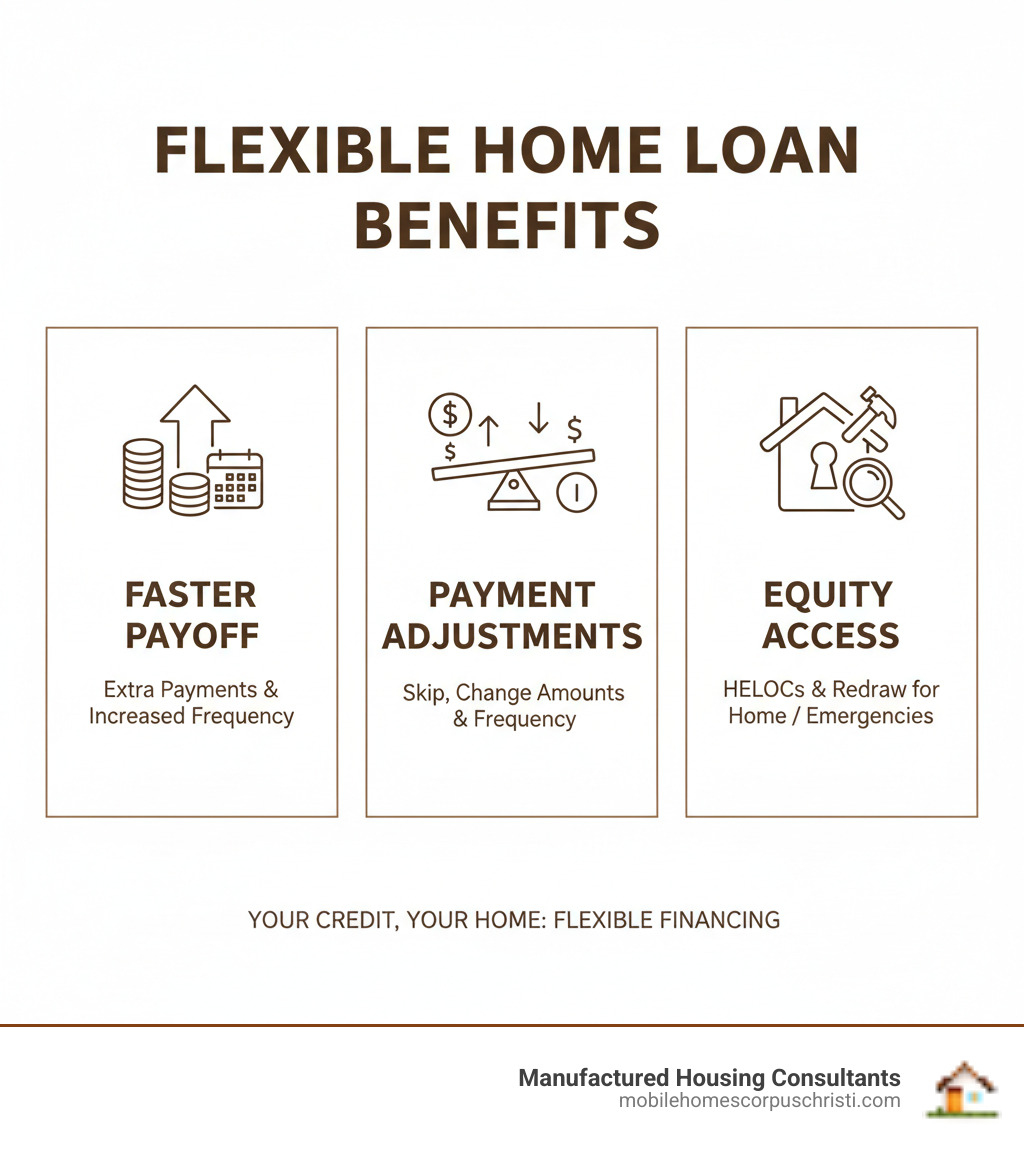
- Flexible Payment Features – Make extra payments, skip payments, or adjust payment frequency
- Prepayment Privileges – Pay up to 15-20% of your principal annually without penalties
- Split Loans – Combine fixed and variable rates for balanced risk management
The research shows that major lenders now offer features like doubling your payments, taking payment vacations, and accessing funds through redraw facilities. For manufactured homes specifically, you can choose between chattel loans (personal property) or traditional mortgages if placed on permanent foundations.
These flexible features help you build equity faster, manage cash flow during tough times, and potentially save thousands in interest over your loan’s life.
Understanding the Landscape of Flexible Home Loan Options
Choosing the right mortgage feels a bit like standing at a crossroads, doesn’t it? Each path leads somewhere different, and the one you pick can shape your financial future for decades. The good news is that today’s flexible home loan options give you more control than ever before.
Think of it this way – your life isn’t set in stone, so why should your mortgage be? Whether you get a raise next year, face an unexpected expense, or decide you want to pay off your home early, flexible financing adapts to your changing needs rather than boxing you in.
Fixed-Rate vs. Variable-Rate Mortgages: Weighing Stability and Opportunity
Let’s start with the classic choice that keeps many homebuyers up at night: fixed-rate versus variable-rate mortgages. Both have their place, and honestly, there’s no universally “right” answer.
Fixed-rate mortgages are like that reliable friend who never changes. Your interest rate stays the same for your entire loan term, which means your monthly payments are completely predictable. You can budget with confidence, knowing exactly what you’ll owe each month. This stability is golden, especially if you’re on a tight budget or just prefer knowing what to expect.
The flip side? If interest rates drop significantly, you’re stuck paying the higher rate unless you refinance – and refinancing comes with its own costs and paperwork headaches.
Variable-rate mortgages are the adventurous option. Your interest rate moves up and down with market conditions, typically tied to your lender’s prime rate. When rates fall, your payments shrink and you save money. When they rise, well, your payments go up too.
But here’s where it gets interesting. Many variable-rate loans come with powerful flexibility features. You might be able to double your payment amount at any time, with that extra money going straight to your principal. Some lenders let you increase your annual payment by up to 15% during your term.
The real safety net? Most lenders offer conversion options that let you switch from variable to fixed rates anytime during your term. So you can ride the wave when rates are favorable, then lock in stability if things start looking rocky.
For manufactured home buyers, these options can be particularly valuable since you’re often working with specialized lending programs. Our team at Manufactured Housing Consultants helps you steer these choices to find what works best for your situation.
Home Equity Lines of Credit (HELOCs): Tapping into Your Home’s Value
Now, let’s talk about one of the most flexible tools in the lending world: Home Equity Lines of Credit, or HELOCs. Think of a HELOC as a credit card backed by your home’s value – except with much better interest rates.
Here’s what makes HELOCs so appealing: they’re revolving credit. You get approved for a credit limit based on your home’s equity, then you can borrow, repay, and borrow again as needed. It’s like having a financial safety net that’s always there.
Many HELOCs also offer term portions alongside the revolving credit. This means you can lock in a fixed or variable rate for a specific amount, then pay it back with structured payments over a set period. You get the best of both worlds – ongoing access to funds plus the stability of predictable payments for larger expenses.
Using home equity opens up so many possibilities. Planning a kitchen renovation? Tap your HELOC. Want to consolidate high-interest credit card debt? Your home equity can help you save thousands in interest. Some lenders let you access up to 80% of your home’s value, giving you serious borrowing power.
The smart money move is using HELOCs for things that add value – like home renovations that boost your property’s worth, or debt consolidation that improves your overall financial picture.
Want to explore how home equity can work for your situation? Check out our financing services to learn more.
Specialized Loans for Manufactured Homes
Here’s where things get really interesting for our customers. Manufactured homes have their own unique financing landscape, and understanding your options can save you money and open doors you didn’t know existed.
The key difference comes down to how your home is classified. If your manufactured home isn’t permanently attached to land you own, you’ll likely be looking at chattel loans. These are personal property loans – think of them like car loans, but for your home. The home itself serves as collateral, terms are typically shorter, and rates might be a bit higher than traditional mortgages.
But here’s the game-changer: if your manufactured home is placed on a permanent foundation and titled as real property, it can often qualify for traditional mortgages. This opens up a whole world of options, including government-backed loans like FHA loans and VA loans.
These traditional mortgage options typically offer better interest rates, lower down payment requirements, and more flexible credit criteria. For many of our customers, this path makes homeownership much more affordable and accessible.
At Manufactured Housing Consultants, we specialize in finding the right financing solution for your specific situation. We work with multiple lenders and understand the ins and outs of manufactured home financing. Whether you need a chattel loan or qualify for a traditional mortgage, we’ll guide you through the process.
Ready to explore your manufactured home financing options? Visit our Manufactured Home Financing Options page to learn more about what’s available for your situation.
Open uping Powerful Payment Features for Financial Control

Flexible home loan options put you in the driver’s seat of your mortgage journey. Whether you want to fast-track your way to being mortgage-free or need some breathing room during tough times, these payment features adapt to your life instead of forcing you to adapt to them.
Think of these features as your financial toolkit – each one designed to help you steer different seasons of life with confidence and control.
Accelerate Your Equity with Prepayment Privileges
Imagine being able to knock years off your mortgage and save thousands in interest with just a few strategic moves. That’s exactly what prepayment privileges allow you to do, and they’re one of the most powerful tools in your flexible home loan options arsenal.
Most lenders are surprisingly generous with these features. You can typically make lump-sum prepayments of 15-20% of your original mortgage amount each year without any penalties. That work bonus you just received? Perfect for a prepayment. Tax refund came in bigger than expected? Another great opportunity to chip away at your principal balance.
Here’s what makes this so exciting: every dollar you put toward your principal today saves you multiple dollars in interest over the life of your loan. It’s like getting a guaranteed return on your investment equal to your mortgage interest rate. Plus, you’re building equity faster, which gives you more financial flexibility down the road.
The beauty of prepayment percentages is that they’re designed to work with real life. Most people don’t have huge chunks of money lying around, but when those opportunities arise – whether it’s 15% or 20% of your original principal – you can seize them without worrying about prepayment charges.
For a deeper understanding of how strategic payments can transform your homeownership experience, Read our New Home Financing Complete Guide.
Adjusting Your Payments to Match Your Cash Flow
Your income probably doesn’t stay the same year after year, so why should your mortgage payments? The most flexible loans let you adjust your payments as your financial situation improves, helping you build equity faster when you can afford it.
Increasing payments is one of the smartest moves you can make when your income grows. Many lenders allow you to boost your regular payment by up to 100% – essentially doubling payments if you want to. Every extra dollar goes straight to your principal, which means you’re not just paying down debt faster; you’re dramatically reducing the total interest you’ll pay.
Changing payment frequency might sound like a small tweak, but it packs a powerful punch. Switching to bi-weekly payments or accelerated payments means you’ll make 26 half-payments per year instead of 12 full payments. That extra payment each year can shave years off your mortgage term without feeling like a major budget strain.
The real magic happens when you combine these features. Maybe you start with accelerated bi-weekly payments, then increase your payment amount when you get a raise. These small adjustments compound over time, building momentum toward your goal of mortgage freedom.
To see how these payment strategies fit into your overall budget planning, check out How to Budget for Your New Manufactured Home.
Taking a Breather: How Payment Pauses or Skips Work
Life happens. Sometimes you need a financial breather, and that’s exactly what payment pauses or skipping a payment features are designed for. These aren’t signs of financial failure – they’re smart tools that help you weather temporary storms without derailing your long-term homeownership goals.
Most flexible loans allow you to skip one payment per year without any penalties. Some even offer payment vacation options where you can pause payments for several months if you’ve been making extra payments. The key is eligibility for pauses – you typically need to be in good standing with your current payments.
Here’s the honest truth: accrued interest will continue during your payment break, so your total loan amount will increase slightly. But this small cost is often worth it to avoid more serious financial stress or having to tap into emergency savings for unexpected expenses.
Financial hardship comes in many forms, and payment flexibility helps you handle life’s curveballs:
- Unexpected medical bills that strain your monthly budget
- Job changes or temporary income reduction
- Family emergencies that require immediate financial attention
- Major home repairs that can’t wait
- Life transitions like starting a family or caring for aging parents
The peace of mind that comes with knowing you have this safety net is invaluable. You can focus on getting back on your feet instead of worrying about your mortgage payment.
These features are designed to be temporary solutions that help you maintain your homeownership during challenging times. They’re part of what makes flexible home loan options so much more than just another mortgage – they’re financial tools that grow and adapt with your life.
Navigating the Application and Eligibility Process

Securing a flexible loan starts with understanding what lenders require and preparing your application for success. The good news? While the process might seem intimidating at first, breaking it down into manageable steps makes it much more approachable. At Manufactured Housing Consultants, we’ve helped countless Texas families steer this journey, and we’re here to make sure you feel confident every step of the way.
What Lenders Look For: Credit, Income, and Down Payments
When you apply for flexible home loan options, lenders essentially want to answer one key question: “Can this person reliably pay back this loan?” To find that answer, they’ll look at three main areas of your financial life.
Your credit score is often the first thing lenders examine. Think of it as your financial report card – it tells the story of how you’ve handled credit in the past. Higher scores typically open up better interest rates and more favorable terms. But here’s what we want you to know: even if your credit isn’t perfect, you still have options. We specialize in helping people with all kinds of credit situations, including offering FICO improvement programs. We truly believe everyone deserves a shot at homeownership.
Next, lenders will dive into your income and employment history. They want to see that you have steady, reliable income to cover your monthly payments. This means they’ll verify your job, salary, and any other income sources you might have. They’ll also calculate your debt-to-income ratio – basically comparing what you owe each month to what you earn. The lower this ratio, the better, because it shows you have breathing room in your budget.
Finally, there’s your down payment. While the amount needed can vary depending on the loan type and your situation, having money to put down shows lenders you’re invested in the purchase. For manufactured homes placed on permanent foundations, you might qualify for programs with lower down payment requirements. A larger down payment can often mean better rates and terms, plus it might help you avoid mortgage insurance altogether.
If you’re wondering how to strengthen your credit before applying, take a look at See the Benefits of Improving Your Credit Score Before Buying a Mobile Home.
The Pre-Approval Advantage for Flexible Home Loan Options
Getting pre-approved isn’t just a nice-to-have – it’s your secret weapon in the home-buying process. Think of it as getting your financial ducks in a row before you start shopping, and it can make all the difference in your experience.
When you’re pre-approved, you’ll know exactly how much you can borrow. This means you can budget with confidence and focus your home search on properties that truly fit your financial picture. No more falling in love with a home that’s out of reach, and no more wondering if you’re looking in the right price range.
Pre-approval also strengthens your offer when you find the right home. Sellers take you seriously when they see that pre-approval letter because it proves you’re not just window shopping – you’re a qualified buyer ready to move forward. This can be especially important in competitive situations where multiple buyers might be interested in the same property.
Perhaps best of all, pre-approval streamlines the entire process. Much of the paperwork and verification is already done, so when you’re ready to make an offer, things can move much faster. This speed can sometimes make the difference between getting your dream home and losing it to another buyer.
Ready to get started? Understand the Pre-Approval Process and learn What You Need to Know about financing to set yourself up for success.
Understanding Loan Protection and Mortgage Insurance
While flexible home loan options give you great control over your payments, it’s smart to think about protecting your investment and your family’s financial future. Life has a way of throwing curveballs, and having the right protection in place can provide incredible peace of mind.
Many lenders offer mortgage protection options that work alongside your flexible loan features. These might include life insurance that pays off your mortgage if something happens to you, disability coverage that helps with payments if you can’t work due to illness or injury, and even job loss protection that provides temporary payment assistance if you lose your employment through no fault of your own.
Think of these protections as creating a financial safety net around your home. While they’re typically optional add-ons to your loan, they ensure that your mortgage payments are covered during life’s most challenging moments. This means your family won’t face the stress of potentially losing their home on top of dealing with other difficulties.
When you’re discussing your financing options with us, we’ll make sure you understand all the protection plans available. After all, buying a home is about creating security for your family, and these protections are just another way to strengthen that foundation.
Frequently Asked Questions about Flexible Home Loans
Let’s tackle some of the most common questions we hear from homebuyers exploring flexible home loan options. These answers will help you make informed decisions about your financing journey.
Can I get one of the flexible home loan options with a lower credit score?
Absolutely! While it’s true that higher credit scores open more doors, having a lower credit score doesn’t mean you’re locked out of homeownership. Many lenders offer specialized programs designed specifically for borrowers with credit challenges, though the terms might be different from those offered to borrowers with excellent credit.
What’s really important is working with financing experts who understand the landscape and can guide you toward the right products. At Manufactured Housing Consultants, we’ve built our reputation on helping people in all credit situations achieve their homeownership dreams. We offer FICO improvement programs alongside our financing services, so we’re not just finding you a loan today – we’re helping you build a stronger financial future.
The key is being upfront about your credit situation from the start. This allows us to match you with lenders who specialize in working with borrowers like you, rather than wasting time with applications that might not be the right fit. Find out more about Low FICO Home Loans to see how we can help turn your homeownership dreams into reality.
What’s the difference between a redraw facility and an offset account?
These two features often get confused because they both help you save money and access funds, but they work quite differently.
An offset account is like having a savings account that’s directly linked to your mortgage. The balance in this account “offsets” your loan principal when calculating interest. So if you have a $200,000 mortgage and keep $20,000 in your offset account, you’ll only pay interest on $180,000. Your money stays accessible in the account, but it’s working hard to reduce your interest payments every single day.
A redraw facility, on the other hand, lets you access extra payments you’ve already made on your mortgage. Think of it as a financial cushion you’ve built into your loan. If you’ve paid an extra $5,000 toward your mortgage principal over time, a redraw facility allows you to “redraw” that money if you need it for emergencies or opportunities.
Both options give you access to funds when you need them, but they impact your interest payments differently. The offset account continuously reduces your interest without touching your loan balance, while the redraw facility temporarily increases your loan balance when you use it.
Are there penalties for using flexible features like prepayments?
This is one of the most important questions to ask, and the good news is that most flexible home loan options are designed to reward you for paying extra, not penalize you. However, there are limits to keep in mind.
Most lenders allow generous penalty-free prepayment amounts annually—often in the 15–20% range of the original principal. These are substantial amounts that give most homeowners plenty of room to accelerate their mortgage payoff.
The potential for penalties usually comes into play in two situations. First, if you exceed your annual prepayment limit, you might face prepayment charges on the excess amount. Second, if you want to break your mortgage entirely before the term ends – perhaps to refinance or sell – there could be penalties, especially with fixed-rate closed mortgages.
The bottom line? Always review your specific loan agreement with your lender before making large prepayments. Understanding your prepayment privileges upfront ensures you can take full advantage of these powerful features without any unwelcome surprises. Most borrowers find they have more flexibility than they initially expected, making it easier to pay off their mortgage faster and save thousands in interest.
Your Path to a Flexible Home Loan Starts Here
Flexible home loan options aren’t a one-size-fits-all solution – they’re powerful tools that bend and adapt to your unique financial story. Think of them as your financial partner, ready to grow with you through life’s ups and downs.
Throughout this guide, we’ve explored how different loan types can serve your needs. Whether you’re drawn to the stability of fixed-rate mortgages, the potential savings of variable rates, or the revolving access of HELOCs, each option offers distinct advantages. We’ve also covered the game-changing payment features that put you in the driver’s seat – from prepayment privileges that can shave years off your mortgage to payment pauses that provide breathing room when life gets challenging.
Understanding the application process is equally important. Your credit score, income stability, and down payment all play crucial roles, but remember – less-than-perfect credit doesn’t have to derail your homeownership dreams. Getting pre-approved gives you confidence and negotiating power, while loan protection options safeguard your investment against unexpected challenges.
At Manufactured Housing Consultants, we’ve made it our mission to steer these complex waters with you. We specialize in finding the perfect financing fit for your credit situation and dream home, whether that’s a cozy tiny home or a spacious family residence. With our guaranteed lowest prices and the largest selection of new mobile and manufactured homes from 11 top manufacturers, we’re equipped to serve clients across Texas with solutions custom to every budget and credit scenario.
Our team understands that manufactured home financing has its own unique considerations – from chattel loans to traditional mortgages for homes on permanent foundations. We work with specialized lenders who understand these nuances and offer FICO improvement programs to help you build toward even better financing options.
Your journey to homeownership doesn’t have to wait. We deliver homes anywhere in Texas and provide ongoing support throughout the financing process. Ready to see what’s possible? Explore our gallery of homes to find your perfect match and find how flexible financing can make your homeownership dreams a reality.