
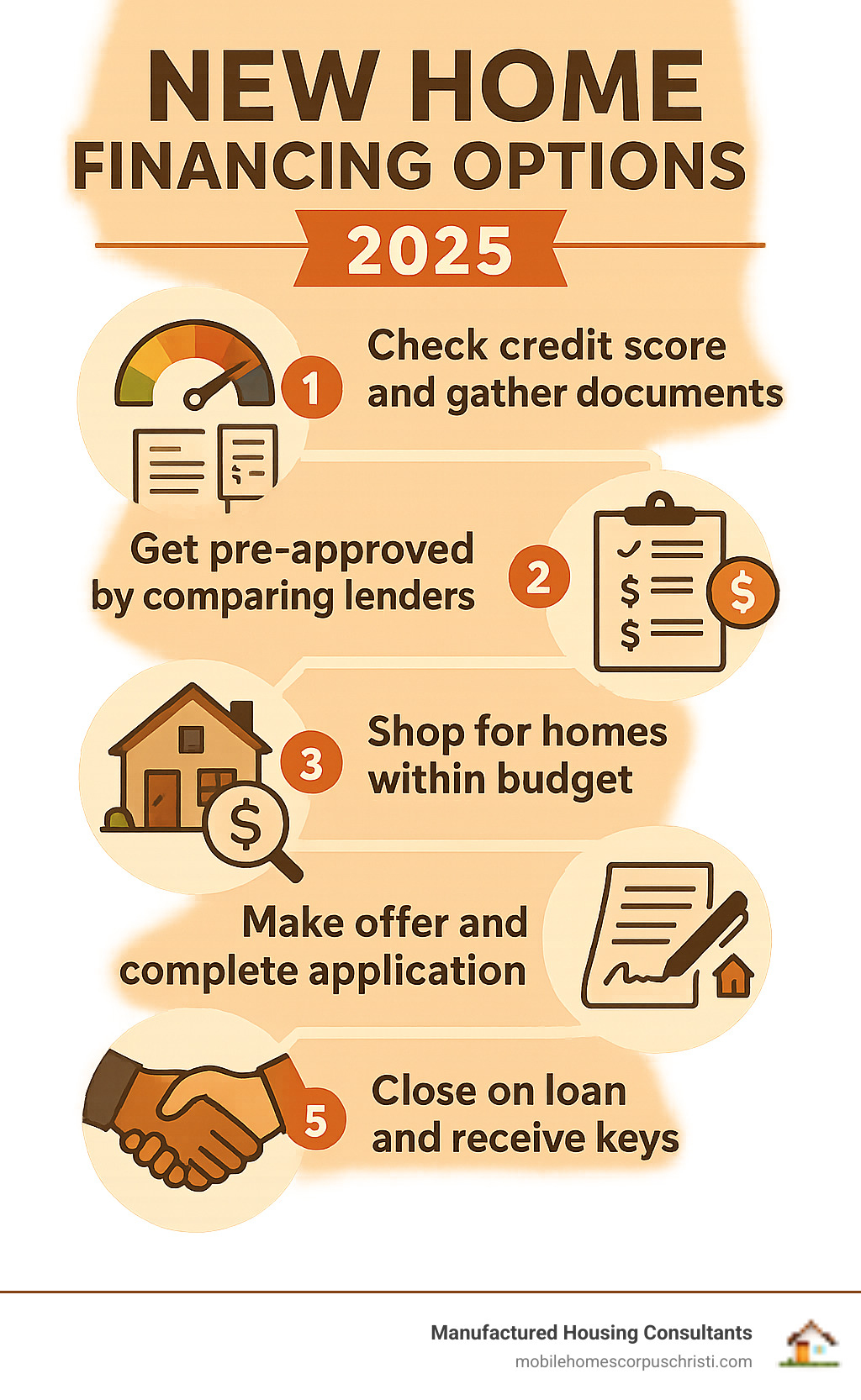
Breaking Down Your Path to Affordable Homeownership
New home financing options have evolved significantly to help more families achieve homeownership, even with credit challenges or limited savings. Today’s mortgage market offers multiple pathways to your dream home, from government-backed programs to specialized manufactured home loans.
Here are the main financing categories available:
- Government-backed loans (FHA, VA, USDA) – Lower down payments, flexible credit requirements
- Conventional loans – Traditional financing through private lenders with competitive rates
- Special purpose programs – State and local assistance for first-time buyers and specific communities
- Manufactured home financing – Specialized loans for factory-built homes with unique benefits
The key difference between these options lies in their down payment requirements, credit score minimums, and eligibility criteria. For example, VA loans require no down payment for eligible veterans, while FHA loans need just 3.5% down with credit scores as low as 580. Conventional loans typically require higher credit scores (620+) but often cost less over time than government-backed options.
Understanding your financing options is crucial because the right loan can save you thousands of dollars and make homeownership possible sooner than you think. Many buyers don’t realize they have access to down payment assistance programs or that manufactured homes qualify for the same government-backed loans as traditional site-built homes.
As one mortgage industry expert noted: “Most borrowers choose fixed-rate mortgages for payment stability,” but adjustable-rate mortgages might offer better short-term affordability for certain situations.
Understanding the Main Mortgage Categories
When exploring new home financing options, it helps to understand the three main mortgage categories. This knowledge can empower you on your homebuying journey.
The main differences are down payment requirements and total loan costs. Some loans require little money down, while others save you more in the long run. At Manufactured Housing Consultants, we’ve helped countless families steer these choices because we believe everyone deserves a clear path to homeownership, regardless of their credit situation.
For those considering manufactured homes specifically, you’ll be happy to know that many of these same financing options apply to your dream home too. More info about mobile home financing.
Conventional Loans
Conventional loans come from private lenders like banks and credit unions without government backing. These loans fall into two camps.
Conforming loans follow rules set by Fannie Mae and Freddie Mac, with a 2024 limit of $766,550 in most areas. Non-conforming loans, or jumbo loans, exceed these limits and may have slightly higher interest rates.

Since there’s no government safety net, lenders are pickier. You’ll typically need a credit score of 620 or higher, though some programs allow as little as 3% down. While tougher to qualify for, conventional loans often cost less over the loan’s lifetime.
Government-Backed Loans
Government-backed loans are insured or guaranteed by federal agencies like the FHA, VA, and USDA. This makes lenders more willing to approve borrowers who might not qualify for conventional loans.
This government backing translates to real benefits for you: lower down payments and more flexible credit requirements. While they’re fantastic for first-time homebuyers, many repeat buyers use these programs too.
Special Purpose & State Programs
Beyond federal programs, State Housing Finance Agencies (HFAs) offer creative solutions for homebuyers. Many programs offer Down Payment Assistance (DPA) to help with upfront cash. Some are grants, while others are “silent second mortgages” that you repay when you sell or refinance.
These programs often target specific groups: low-to-middle income borrowers, first-time homebuyers, or public service employees like teachers and firefighters. There are even special programs designed to help specific communities.
Many people don’t know these programs exist. Find your state housing finance agency (HFA) to see what might be available in your area.
A Closer Look at Government-Backed Loans
Government-backed loans are designed for everyday families. The federal government guarantees a portion of the loan, making lenders more comfortable approving borrowers who might not qualify for conventional financing.
This allows lenders to offer better terms, like lower down payments and flexible credit requirements, giving you access to homeownership that might otherwise be out of reach.
Federal Housing Administration (FHA) Loans
FHA loans are one of the most popular new home financing options. The Federal Housing Administration insures these loans, allowing lenders to offer flexible terms.
First-time homebuyers often choose FHA loans. They require only a 3.5% down payment for credit scores of 580 or higher. You may still qualify with a score between 500 and 579 by putting 10% down.
The trade-off is the required Mortgage Insurance Premium (MIP), which protects the lender and adds to your monthly payment. Many find it’s worth it for the easier qualification.
The great news is that FHA loans work perfectly for manufactured homes too, giving you the same benefits whether you’re buying a traditional site-built home or a beautiful new manufactured home.
U.S. Department of Veterans Affairs (VA) Loans
VA loans are a valuable benefit for eligible veterans, active-duty service members, and certain surviving spouses. They are guaranteed by the U.S. Department of Veterans Affairs.
The benefits are remarkable: no down payment required and no Private Mortgage Insurance (PMI). This can save you tens of thousands of dollars. It’s our nation’s way of saying thank you for your service.
To get started, you’ll need a Certificate of Eligibility (COE) from the VA. These benefits extend to manufactured homes as well, opening up more affordable housing options.
U.S. Department of Agriculture (USDA) Loans
USDA loans promote homeownership in designated rural and suburban areas, many of which are surprisingly close to cities. These loans are perfect for low-to-moderate income borrowers and often require no down payment.
However, these loans do come with income limits based on your area’s median income, and the property must be in an eligible rural zone. You can easily check a property’s eligibility on the USDA’s website.
Navigating Conventional Loans and Their Features
Conventional loans are a popular choice with features that affect your monthly and long-term costs. Understanding loan terms, interest rates, and Private Mortgage Insurance (PMI) is key to making a smart decision about building equity in your new home.
How to budget for your new home
Fixed-Rate vs. Adjustable-Rate Mortgages (ARMs)
Choosing between a fixed-rate and an adjustable-rate mortgage (ARM) is a major decision. It’s a choice between payment predictability and a potentially lower initial rate that could change later.
With a fixed-rate mortgage, your interest rate and principal-and-interest payment are locked in for the life of the loan, making budgeting predictable. This stability is why most buyers choose this option.
Adjustable-rate mortgages (ARMs) have a fixed rate for an initial period (e.g., 5 or 7 years), after which the rate adjusts based on the market. This often means a lower starting rate, but your payments could increase later.
Here’s how they stack up:
| Feature | Fixed-Rate Mortgage | Adjustable-Rate Mortgage (ARM) |
|---|---|---|
| Payment Stability | High (payments remain the same) | Low (payments can change after fixed period) |
| Interest Rate Risk | Low (no surprises) | High (rate can increase) |
| Initial Rate | Typically higher than initial ARM rates | Often lower than fixed rates |
| Ideal Borrower | Values predictability, long-term stay | Plans to move soon, comfortable with risk |
ARMs aren’t as scary as they sound because they come with rate caps that limit how much your rate can jump. Still, they work best if you plan to move before the adjustment period kicks in.
Loan Terms: 15-Year vs. 30-Year
Your loan term creates a trade-off between your monthly payment amount and the total interest you’ll pay.
A 15-year mortgage has higher monthly payments but a lower interest rate. You’ll pay less interest overall, build equity much faster, and own your home in half the time.
A 30-year mortgage offers lower monthly payments, making homeownership more affordable day-to-day. The trade-off is paying more interest over the long-term, but many families find the short-term affordability worth it.
Understanding Private Mortgage Insurance (PMI)
If your down payment on a conventional loan is less than 20%, you’ll pay Private Mortgage Insurance (PMI). This protects the lender if you can’t make payments.
PMI adds to your monthly housing costs. The cost of PMI typically ranges from 0.3% to 1.5% of your loan amount annually, depending on your credit score and down payment.
The good news? PMI isn’t permanent. Your lender must automatically cancel it once you reach 22% equity in your home (78% loan-to-value ratio). You can also request removal once you hit 20% equity with a good payment history.
Opening up Opportunity with Specialty Programs and New Home Financing Options
Beyond standard loans, specialty programs offer new home financing options for specific needs, such as for first-time homebuyers or those wanting to finance energy-efficient upgrades.

Exploring new home financing options for first-time buyers
Many programs cater to first-time homebuyers, helping with the biggest challenge: the down payment and closing costs.
Down Payment Assistance (DPA) Programs, offered by state or local housing agencies, are a great resource. They come as grants (which don’t need to be repaid) or low-interest/deferred-payment loans.
Closing cost grants work similarly, helping to cover expenses like appraisal fees and title insurance.
Most of these programs require a homebuyer education course, which provides valuable information on the mortgage process, budgeting, and the responsibilities of homeownership.
Using Retirement Funds for Your Down Payment
Many first-time homebuyers can use retirement savings for a down payment. You can typically withdraw up to $10,000 from an Individual Retirement Account (IRA) penalty-free for a first home purchase.
With a Traditional IRA, you’ll owe income tax on the withdrawal. With a Roth IRA, you can withdraw contributions tax- and penalty-free. If your account has been open for at least five years, you can also withdraw earnings tax-free for your first home.
The $10,000 limit is per person, so a married couple could potentially access $20,000. Always consult a financial advisor about tax implications.
Energy-Efficient and Renovation Mortgages
HomeStyle Energy mortgages let you finance energy and water improvements directly into your loan, avoiding the need for separate financing. You can finance upgrades like ENERGY-STAR certified windows, new HVAC systems, or solar panels, up to 15% of your home’s improved value.
HomeStyle Renovation loans work similarly but cover broader improvements. You can even combine both programs. This approach rolls everything into one mortgage payment, can lower utility bills, and increase your home’s value.
Key Factors and Common Pitfalls in Home Financing
To get the best new home financing options, you must understand what drives loan terms and how to avoid common pitfalls. Your credit score is a major factor, but paths to homeownership exist even with credit challenges.
Benefits of improving your credit score
What are my new home financing options with a lower credit score?
Your FICO score (ranging from 300-850) is a key factor lenders use to assess risk. Along with your debt-to-income (DTI) ratio, income, and assets, it helps determine your eligibility and interest rate.
While conventional loans typically require a credit score of 620+, don’t be discouraged by a lower score. FHA loans are designed for these situations, allowing you to qualify with a score as low as 580 (3.5% down) or even 500 (10% down).
At Manufactured Housing Consultants, we specialize in new home financing options for all credit situations. We’ve helped countless families achieve homeownership, even when they thought their credit scores made it impossible. We also provide guidance on improving your FICO score, which can open doors to better loan terms.
Avoiding Risky Loan Features
Some loans have risky features that can cause future financial problems. These are often found in non-qualified mortgages (Non-QM), which lack the federal protections of qualified mortgages (QM).
Watch out for these red flags:
- Prepayment penalties: A fee for paying off your loan early, which can trap you in a loan when better options are available.
- Balloon payments: These loans require a large lump-sum payment at the end of the term, which can force you to sell or refinance if you can’t pay it.
- Negative amortization: Your loan balance grows over time because your payment doesn’t cover all the interest due.
- Interest-only loans: You don’t build any equity during the interest-only period, and your payments will jump significantly later.
The key is working with a reputable lender. At Manufactured Housing Consultants, we believe in complete transparency and will never pressure you into a loan that isn’t in your best interest.
Frequently Asked Questions about New Home Financing
Here are answers to some of the most common questions we receive about new home financing options.
What is the minimum down payment for a new home?
The minimum down payment depends on your loan program, and it’s often less than people think.
- VA loans (for eligible veterans) and USDA loans (for eligible rural properties) often require zero down payment.
- FHA loans are a great option, requiring as little as 3.5% down with a credit score of 580+, or 10% down for scores between 500-579.
- Some conventional loans allow down payments as low as 3-5%. A 20% down payment is ideal to avoid Private Mortgage Insurance (PMI), but it’s not required.
- Down Payment Assistance (DPA) programs can often help cover these costs, making homeownership possible sooner.
How do lenders determine my interest rate?
Lenders determine your interest rate based on several risk factors. Understanding them can help you secure a better rate. Key factors include your credit score, loan type and term, down payment size, debt-to-income (DTI) ratio, and current market conditions. A higher credit score and larger down payment typically result in a lower interest rate.
Can I get a loan for a manufactured home?
Yes! This is a common misconception. Manufactured homes qualify for many of the same new home financing options as site-built homes.
- FHA loans (both Title I for the home only and Title II for home and land) are popular for manufactured homes, offering low down payments and flexible credit requirements.
- VA and USDA loans can also be used for qualifying manufactured homes on permanent foundations, offering the same zero-down-payment benefit.
- Conventional loan programs, like Fannie Mae’s MH Advantage and Freddie Mac’s CHOICEHome, also offer competitive financing for manufactured homes.
- Chattel mortgages are another option. These are personal property loans for the home itself (not the land) and often close faster than traditional mortgages.
At Manufactured Housing Consultants, manufactured home financing is what we do every day. We understand the unique aspects of these loans and can guide you to the right option for your specific situation.
Your Next Step Towards Homeownership
We hope this guide has shown the variety of new home financing options available. Whether you’re a first-time buyer, a veteran, or looking at manufactured homes, there’s a path for you.
The journey to homeownership is manageable with the right support. The key is finding the right combination of loan type, assistance programs, and terms for your budget.
At Manufactured Housing Consultants, we make homeownership accessible and affordable. We offer specialized financing for all credit situations, from FICO score improvement to down payment solutions. Our team has the experience to help you find the right path forward.
We offer the largest selection of new mobile and manufactured homes from 11 top manufacturers at guaranteed lowest prices. Our commitment is to help you secure financing that makes sense, guiding you every step of the way.
We deliver homes anywhere in Texas, so no matter where you want to plant your roots, we can help. Our team in Corpus Christi has helped countless families find their perfect home.
Don’t let uncertainty about financing hold you back. Your dream of homeownership is closer than you think, and we’re here to help you make it a reality.